
Can SoftWave Therapy Help Plantar Fasciitis?

That first step out of bed in the morning. The one that makes you wince, hold the wall, and wonder how something in your foot can hurt this much before you’ve even had coffee.
If that sounds familiar, you’re likely dealing with plantar fasciitis and you’re probably tired of being told to stretch more and rest. So let’s talk about something different: can SoftWave therapy help plantar fasciitis, and is it the right next step for you?
What Is Plantar Fasciitis?
The plantar fascia is a thick band of tissue that runs along the bottom of your foot, connecting your heel bone to your toes. When it gets overloaded – through repetitive impact, poor foot mechanics, or prolonged standing – small tears and inflammation develop at the attachment point near the heel.
The result is sharp, stabbing heel pain that’s often worse with the first steps of the day or after sitting for a while. It tends to ease with movement, then flare up again with extended activity.
Here’s the part most people don’t know: plantar fasciitis can become chronic. When the tissue never fully heals between flare-ups, it enters a cycle of partial repair and re-injury. That’s when standard treatments – rest, ice, stretching – start falling short.
What Is SoftWave Therapy?
SoftWave therapy is a non-invasive acoustic wave treatment that delivers focused energy pulses into damaged tissue. It belongs to the broader family of extracorporeal shockwave therapy (ESWT) – a category with decades of clinical research behind it – but uses a specific unfocused wave pattern designed to cover a wider treatment area while staying comfortable for the patient.
The device is applied directly to the skin with ultrasound gel. Sessions are brief – typically 10–15 minutes – and require no anesthesia, no needles, and no downtime.
At Tinker Family Chiropractic, we use SoftWave as a targeted, evidence-informed option for heel pain and plantar fasciitis – particularly in patients who haven’t gotten lasting relief from conservative care alone.
Can SoftWave Therapy Really Help Plantar Fasciitis?
Yes – and the research on shockwave therapy for this condition is one of the stronger evidence bases in the non-surgical treatment world.
A 2024 meta-analysis published in the Journal of Orthopaedics reviewed 15 randomized controlled trials involving 1,123 patients and found that ESWT performed significantly better than placebo for plantar fasciitis pain scores. It also outperformed orthotics, physical therapy, and corticosteroid injections in head-to-head comparisons.
A randomized, placebo-controlled trial published in Muscles, Ligaments and Tendons Journal found that ESWT significantly reduced plantar fascia thickness and pain scores compared to sham therapy – with measurable tissue changes visible on ultrasound imaging.
For stubborn, long-lasting heel pain specifically, shockwave therapy for plantar fasciitis has become one of the most recommended non-surgical interventions available.
How SoftWave Therapy Works for Plantar Fasciitis
The mechanism is what separates this treatment from options that simply mask pain. SoftWave doesn’t numb the area or block pain signals. Instead, it works by triggering the body’s own repair process.
Here’s what happens at the tissue level:
- Stimulates circulation – Acoustic waves increase blood flow to the damaged area, delivering oxygen and nutrients that chronic tissue often lacks
- Supports tissue repair – The waves activate stem cells and growth factors that drive cellular regeneration in the plantar fascia
- Reduces inflammation – By disrupting the inflammatory cycle at the tissue level, SoftWave addresses the underlying cause rather than just the symptom
- Breaks down chronic scar tissue – Older, hardened tissue that’s restricting normal healing is broken up, allowing the body to rebuild properly
This is exactly why SoftWave therapy for plantar fasciitis tends to be most effective for chronic cases – situations where the tissue has been stuck in a partial-healing loop for months.
Who Is a Good Candidate for SoftWave Therapy?
SoftWave tends to be the right fit when:
- Heel pain has lasted more than 3 months despite conservative care
- You’ve tried stretching, rest, ice, and orthotics with limited improvement
- You’re an active adult, runner, or someone on your feet all day who needs a faster return to activity
- You want to avoid cortisone injections or surgery
- You’re looking for a non-surgical plantar fasciitis treatment that addresses the root cause
Most patients are good candidates if they’re healthy adults with a confirmed plantar fasciitis diagnosis and no contraindications (more on that below).
When SoftWave May Not Be the First Step
We believe in giving every patient an honest picture. SoftWave isn’t necessarily the first move for everyone.
If your heel pain started recently – within the past few weeks – standard conservative care (stretching, activity modification, supportive footwear) may still be enough. Starting with acoustic wave therapy before giving those options a real chance isn’t always necessary.
It’s also worth noting that not all heel pain is plantar fasciitis. Heel spurs, nerve entrapment, Achilles tendinopathy, and stress fractures can all cause similar symptoms. A proper evaluation matters before starting any treatment – including this one.
How Many SoftWave Treatments Are Usually Needed?
Results vary by severity and how long the condition has been present. A general guide:
- Mild to moderate cases: 3–5 sessions, typically spaced one week apart
- Chronic plantar fasciitis cases: May benefit from 6–8 sessions with a structured follow-up plan
- Highly active patients (runners, athletes): Response time can vary with continued high-demand activity
The key thing to understand: SoftWave initiates a biological healing process. That process doesn’t stop at the end of the session – it continues for weeks. So patience with the full timeline is part of getting the most out of treatment.
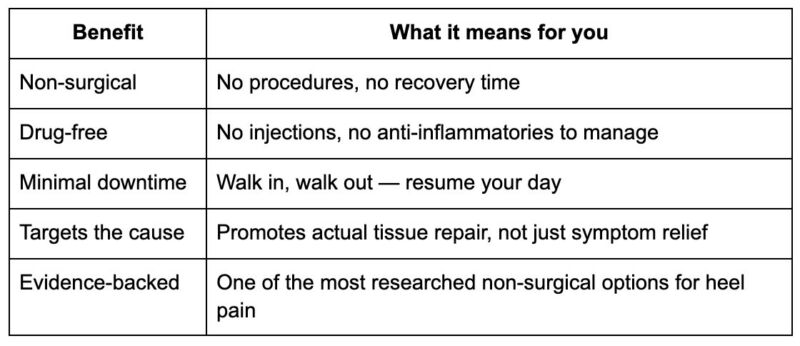
Benefits of SoftWave Therapy for Plantar Fasciitis
How Tinker Family Chiropractic Approaches Heel Pain and Plantar Fasciitis
We offer SoftWave therapy right here in Mt. Juliet. As your Chiropractor in Mt. Juliet, TN, Dr. Brittany Tinker evaluates every heel pain patient individually – because the right treatment starts with the right diagnosis.
Our approach isn’t one-size-fits-all. We assess your symptoms, activity level, history of treatment, and overall foot and spinal mechanics before building a care plan. SoftWave may be part of that plan, alongside supportive chiropractic care and rehabilitation guidance.
If you’ve been dealing with plantar fasciitis and you’re ready for a real answer, we’d love to help you find it.
Final Takeaway
Can SoftWave therapy help plantar fasciitis? For most patients with persistent or recurring heel pain, the answer is yes and the research backs it up. It’s non-invasive, drug-free, and designed to support real tissue healing rather than just temporarily quieting symptoms.
It works best when symptoms are chronic, when basic treatments have run their course, and when you’re ready to invest in a structured approach rather than hoping the pain goes away on its own.
A proper evaluation is still the right first move – because not every heel pain case is the same, and the best treatment depends on knowing exactly what you’re dealing with.
$69
Exam + X-Rays
Once you qualify for care, the doctor will go over the next steps, and any cost associated with care before moving forward.