
Conditions:
Neck Pain Relief
Mt. Juliet, Tennessee
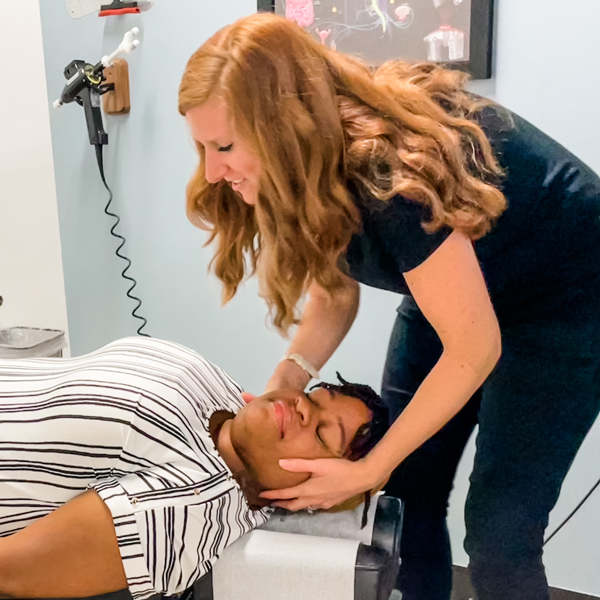 Neck pain has a way of making everything harder. Checking your blind spot while driving. Looking down at your phone. Turning to talk to someone across the table. Things that should be effortless suddenly require thought – and sometimes they hurt enough to stop you entirely.
Most people try to wait neck pain out. They sleep on a different pillow, take some ibuprofen, apply a heating pad, and hope it resolves on its own. Sometimes it does. But when it keeps coming back, or when it never fully goes away in the first place, that’s your body signaling that something deeper is going on.
At Tinker Family Chiropractic, Dr. Brittany Tinker specializes in finding exactly what that something is. The cervical spine – the seven vertebrae that form your neck – is one of the most mobile and most vulnerable parts of the entire spinal column. When it’s not moving the way it should, you feel it in ways that go well beyond just your neck.
Why Neck Pain Is So Common – and So Often Misunderstood
The neck carries your head, which weighs somewhere between 10 and 12 pounds. That’s manageable when your head sits directly over your shoulders. But for every inch your head shifts forward – which happens naturally when you look down at a screen or slouch at a desk – the effective load on your cervical spine increases dramatically. By the time your head is just two or three inches forward, your neck muscles are managing the equivalent of 30 to 40 pounds of strain. Hour after hour, day after day, that adds up.
This is why neck pain is no longer just a problem for people who’ve been in accidents. It’s become one of the most common complaints we see across all ages – from professionals who work at computers to teenagers who spend hours on their phones to parents who spend years carrying children on one hip.
What makes it tricky is that the underlying cause is often structural, not something you can stretch or rest your way out of. Common sources of neck pain we treat include:
- Cervical subluxations – vertebrae in the neck that have shifted out of proper alignment, creating nerve pressure and muscle tension
- Whiplash injuries – often from car accidents, but also from sports, falls, or any sudden forceful movement of the head
- Tech neck / forward head posture – a pattern of misalignment that develops gradually from prolonged screen use
- Herniated or bulging cervical discs – when disc material presses on nerves exiting the cervical spine, causing pain, numbness, or weakness into the shoulder and arm
- Cervical stenosis – narrowing of the spinal canal in the neck, more common as we age
- Muscle strain and spasm – often a secondary response to an underlying structural issue, not the cause itself
- Stress and tension – which tends to concentrate in the neck and upper traps, especially when there’s already an underlying alignment problem
The difference between getting relief that lasts and getting relief that wears off in a day or two usually comes down to whether the actual structural issue has been identified and addressed.
What Treating Neck Pain at Tinker Family Chiropractic Looks Like
Because neck pain has so many potential causes – and because the cervical spine sits in close proximity to critical nerves and blood vessels – precision matters more here than almost anywhere else on the spine. Dr. Tinker’s approach reflects that.
Step 1: A Real Conversation About Your Neck
Your first visit starts with Dr. Tinker listening – to how the pain started, what it feels like, where it travels, what makes it better or worse, and how long it’s been affecting you. If there was an injury involved, she wants to know the details. If it came on gradually, she’ll ask about your daily habits, your workstation, how you sleep. This context shapes everything that follows.
Step 2: Advanced X-Ray Analysis
Digital X-rays of the cervical spine give Dr. Tinker an objective, precise picture of what’s happening – the degree of curvature (or loss of curvature), the position of each vertebra relative to the ones above and below it, and any structural changes that need to be factored into your care. This step isn’t optional for us because it’s the difference between guessing and knowing.
A healthy cervical spine has a gentle forward curve called a lordosis. Many patients who come in with chronic neck pain have lost part or all of that curve – something that doesn’t show up on surface-level assessment but is immediately visible on X-ray and directly affects how the neck functions under load.
Step 3: Advanced Spinal Correction for the Cervical Spine
Corrective chiropractic care for the neck involves more than a single adjustment. Using precise, low-force techniques specifically suited to the cervical spine, Dr. Tinker works to restore proper vertebral alignment and, over time, to rehabilitate the natural curve.
Depending on your case, this may also include cervical traction – a gentle decompression technique that takes pressure off compressed discs and nerve roots – along with hands-on soft tissue work to release the muscle guarding that builds up around a misaligned spine.
Step 4: Targeted Neck Exercises and Rehabilitation
The adjustments do the heavy lifting, but the muscles surrounding your cervical spine play a major role in holding your correction and preventing re-injury. Dr. Tinker will give you specific strengthening and mobility exercises designed for your case – not a generic printout, but a plan built around what your X-rays show and what your daily life demands.
When Neck Pain Becomes Something More
One of the most important things to understand about the cervical spine is how much it connects to. The nerves that exit through the cervical vertebrae travel into your shoulders, arms, hands, and fingers. They also influence your head – including blood flow and nerve signals that relate to headaches, dizziness, and jaw tension.
This is why patients who come in primarily for neck pain often report improvements in other areas too. Headaches that had been a weekly occurrence become infrequent. Numbness in the fingers that was written off as a wrist problem resolves after the cervical spine is addressed. These connections aren’t coincidences – they reflect the reality that the spine and nervous system don’t operate in isolated segments.
If your neck pain is accompanied by any of the following, it’s especially important to get evaluated promptly:
- Pain, numbness, or tingling that radiates into your shoulder, arm, or hand
- Headaches that start at the base of the skull and move forward
- Dizziness or a sense of imbalance
- Weakness in your grip or arm
- Pain that worsens significantly with certain head positions
- Neck stiffness that came on suddenly after an accident or fall
When to Come In
You don’t need to be in crisis-level pain to benefit from getting your neck evaluated. In fact, the earlier a cervical issue is identified, the more straightforward it typically is to correct – before misalignment leads to disc degeneration, chronic muscle guarding, or postural changes that take longer to unwind.
These are the most common signals that it’s time to schedule a visit:
- Neck pain or stiffness that has persisted for more than a few days
- Pain that keeps returning after temporary relief
- Morning stiffness that takes a while to loosen up
- Reduced range of motion – difficulty turning your head fully to one side
- Neck tension that becomes headaches by the end of the day
- Any neck pain that followed a car accident, even a minor one – whiplash symptoms can take days to fully appear
- Recurring “cricks” that seem to happen more and more frequently
Serving Mt. Juliet, Wilson County, and the Greater Nashville Area
Tinker Family Chiropractic is located at 12908 Lebanon Rd in Mt. Juliet, serving patients from throughout Wilson County and the surrounding communities, including Lebanon, Watertown, Hermitage, and the eastern Nashville suburbs. If you’ve been looking for a neck pain chiropractor in Mt. Juliet who takes the time to actually understand what’s happening in your spine before deciding how to treat it, we’d love to be that practice for your family.
Not sure if chiropractic is the right move for your neck? Let’s find out. Your first visit includes a full consultation with Dr. Brittany Tinker, digital cervical X-rays (when indicated), and a clear explanation of what’s going on – before you commit to anything further.
Call us at (615) 510-6145 or schedule online.
Frequently Asked Questions About Neck Pain
Can a chiropractor actually help with neck pain, or is it just temporary relief? This depends entirely on the approach. Adjustments that focus only on symptom relief often do produce temporary results – you feel better for a day or two, then the pain returns because the underlying alignment issue hasn’t changed. Dr. Tinker’s corrective approach is designed to address the structural cause, which means results that hold over time. The length of care depends on how significant the misalignment is and how long it’s been there, but the goal is always long-term correction, not ongoing dependency.
I was in a car accident a few weeks ago. My neck has been sore but I didn’t think it was serious. Should I still come in? Yes – and the sooner the better. Whiplash injuries are notoriously deceptive. The initial adrenaline of an accident can mask symptoms for days, and by the time pain becomes significant, inflammatory processes are already well underway. Cervical misalignments from whiplash don’t resolve on their own and can lead to chronic pain and disc damage if left unaddressed. An evaluation and X-rays will tell us exactly what happened to your spine in the accident.
What if I’ve already had a cervical MRI or seen a specialist who said everything looks normal? It’s not uncommon for patients to arrive at our office after being told by their medical provider that imaging looks normal – yet their pain is very real. MRI and CT scans are excellent tools for identifying disc herniations, bone spurs, and tissue damage, but they don’t capture spinal alignment under load the way standing X-rays do. Many cervical issues that produce significant pain are positional and biomechanical in nature, not structural pathology. That’s precisely where chiropractic evaluation adds value.
Is neck adjustment safe? Yes, when performed by a trained, licensed chiropractor. Dr. Tinker uses techniques appropriate to each patient’s specific anatomy, history, and presentation – she doesn’t apply the same adjustment to every neck. Cervical manipulation has been extensively studied and has a strong safety record when performed by qualified practitioners. If there’s any reason a particular technique is contraindicated for your case, she’ll discuss alternatives.
My neck pain seems to be connected to my headaches. Can chiropractic help with both? Very often, yes. The suboccipital region – the junction between the cervical spine and the base of the skull – is a common source of cervicogenic headaches, meaning headaches that originate from the neck rather than from the head itself. When the upper cervical vertebrae are misaligned, the nerves and muscles in that region become irritated and refer pain forward into the head. Correcting the cervical alignment frequently reduces or eliminates these headaches without any medication involved.
Do you treat neck pain in kids? Yes. Children and teenagers are increasingly presenting with neck issues related to screen use and heavy backpacks, and Dr. Tinker sees patients of all ages. Pediatric cervical adjustments are gentle and adapted entirely to a child’s size – there’s no resemblance to an adult adjustment. If your child is complaining of neck pain or headaches, it’s worth having their spine evaluated.
Conditions
At Tinker Family Chiropractic – your trusted chiropractor in Mt. Juliet, we know every patient faces unique conditions and challenges. That’s why we go beyond basic care, focusing on understanding your needs and delivering personalized chiropractic solutions that truly make a difference.
