
Text Neck Syndrome Explained: Causes, Symptoms, Treatment and Prevention

Text neck syndrome explained in one line: it is neck pain and stiffness that builds from hours spent looking down at a screen.
Phones and laptops are part of everyday life, but spending too much time looking down can put ongoing strain on your neck. If symptoms keep returning, a Chiropractor in Mount Juliet, TN can help evaluate whether posture, spinal movement, or other factors may be contributing. This guide covers the common symptoms, causes, treatment options, exercises, and ways to prevent text neck.
What is text neck syndrome
Text neck is neck pain, stiffness, and shoulder tension from holding your head forward and down over a device. You will also see it called tech neck. Same thing.
The name spread around 2008, when a chiropractor used it for a pattern he kept seeing in younger patients. It describes a habit, not a textbook diagnosis.
Here is the difference that matters. Everyone gets a stiff neck sometimes and it clears in two days. Text neck repeats, so the strain never settles before the next round starts.
Why does text neck happen?
Forward head posture increases the load
Your neck supports your head most efficiently when it stays balanced over your shoulders. When you lean forward to look at a phone, laptop, or tablet, the muscles and tissues around your neck have to work harder to maintain that position.
Holding this posture for hours at a time can place ongoing strain on the neck. Three things may happen over time.
Muscle fatigue. The small muscles at the back of your neck were built for balance, not for holding weight all afternoon.
Ligaments stretch. Tissue held at end range loses some of its spring.
Discs load unevenly. Forward bending presses the front of the neck discs harder than the back.
Daily habits that cause text neck
The usual sources, in order of how often we see them: a phone held at lap height, a laptop screen below eye level, tablets flat on a desk, reading in bed, long gaming sessions at a low monitor, and a workstation nobody adjusted.
Common symptoms of text neck syndrome
Symptoms arrive in stages. Knowing your stage tells you how urgent this is.
Early symptoms
Stiffness turning your head. Aching at the base of the neck by late afternoon. Tight shoulders. At this stage it eases overnight and returns the next day.
Moderate symptoms
Headaches starting at the base of the skull. Less range of motion, so reversing the car becomes a whole body turn. Spasms that grab without warning.
Advanced symptoms
Tingling down an arm. Numbness in a hand. Weakness gripping a mug. Pain travelling from neck into arm. A head that no longer returns to neutral off the phone.
Anything in this last group needs a proper examination now.
Can text neck cause permanent damage?
Usually not, and the internet oversells this one.
Long term forward head posture does track with real changes. Loss of the natural neck curve, faster disc wear, herniated discs in some people, nerve irritation where the space narrows, arthritic change at the small joints, and less movement overall.
Now the part most articles skip. The link between posture and pain is weaker than it sounds. Studies keep finding people with obvious forward head posture and no pain, alongside people with textbook posture and plenty of it. Staying still for hours matters more than the shape of your neck in a photograph.
So a few years of phone use will not wreck your spine. Pain returning for months, or any nerve symptom, still deserves a look.
Who is most at risk?
Office workers, students, teenagers, remote workers, gamers, and anyone charting on a tablet at waist height. Broadly, anyone with hours of daily screen time and no habit of getting up.
How is text neck diagnosed?
No single test covers it. A proper evaluation stacks several.
It starts with your history and what your workday looks like. Then a postural assessment measuring how far forward your head sits, an examination of the joints reproducing your symptoms, and range of motion testing. Tingling or weakness adds a neurological check of reflexes and strength.
Standing digital X-rays get taken when alignment needs measuring, because they show the neck curve under real load. MRI is held back for nerve symptoms that persist.
Treatment for text neck syndrome
Reduce the source of strain
Nothing else holds if the cause runs eight hours a day. Raise your screen to eye level, bring the phone up instead of dropping your head, and move every 20 to 30 minutes.
Physical therapy
A structured plan mixes three things. Mobility works to win back lost motion, strengthening for the deep neck flexors and the mid back, and stretching for what has shortened at the front.
Chiropractic care
Adjustments restore motion to segments that stopped moving, which settles the muscle guarding around them. Postural correction and rehabilitation exercises then deal with why the pattern formed, so relief holds.
The combination is the point. Adjustments alone rarely beat a problem that eight hours a day keeps rebuilding.
Other conservative options
Massage and soft tissue work for the tight bands across your shoulders. Heat before activity, ice after a flare. Anti inflammatory medication has a short term role when a physician recommends it, though it quiets the signal, not the cause.
Best exercises for text neck
Daily. Most take under a minute.
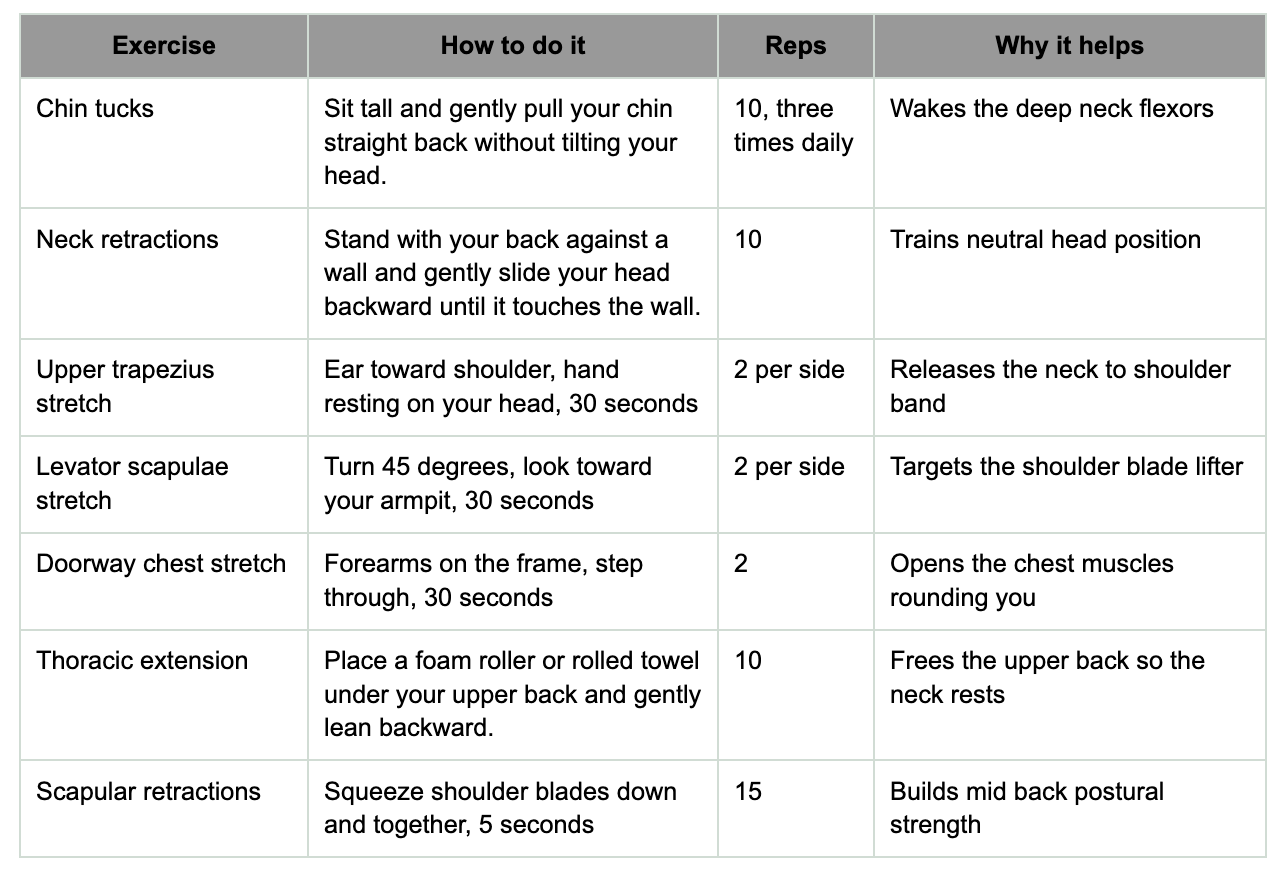
Stop any of these if you get sharp pain or tingling, and get assessed instead.
How to prevent text neck
Raise your phone. Bring the device to your eyes, not your eyes to the device. This one change removes most of the daily load.
Fix your workstation. Screen top at eye level, elbows near 90 degrees, feet flat, monitor an arm’s length off.
Follow the 20 to 30 minute rule. Stand, roll your shoulders, look at something far away. Frequency beats duration.
Strengthen the postural muscles. Two or three mid back sessions a week turn good posture into something you hold without thinking.
Cut optional screen time, especially scrolling done with your head lowest.
Hold devices with both hands. Two hands lift the screen higher than one.
When should you see a healthcare professional?
Book an evaluation for pain lasting more than a few weeks despite a better setup, pins and needles, numb patches, weakness gripping or lifting, headaches unlike your usual ones, or lost balance. Neck pain after a fall or a crash belongs in urgent care first.
Why choose Tinker Family Chiropractic for Text Neck?
Text neck is one of the most common posture related conditions we see. At Tinker Family Chiropractic, every evaluation begins with understanding the cause of your symptoms, not just where it hurts.
Dr. Brittany Tinker uses Advanced X-ray Analysis to evaluate spinal alignment and develops personalized care plans that may include Advanced Spinal Correction and spinal rehabilitation exercises based on your individual needs.
If your neck pain or stiffness has lasted for weeks or keeps returning, a professional evaluation can help determine what’s really causing your symptoms.
Contact us to schedule an appointment and get started.
Frequently asked questions
Can text neck be reversed?
Often, particularly the pain and stiffness. Posture and movement improve for most people who stay with a plan for several weeks.
How long does recovery take?
Mild cases ease in two to four weeks. Long standing postural change needs two to three months of consistent work.
Does chiropractic help the text neck?
It helps most with restricted joint motion and the muscle tension that follows. It works best beside exercise and a better desk setup, not instead of them.
What is the best sleeping position for a text neck?
On your back with a pillow supporting the neck curve, or on your side with one thick enough to keep your head level. Face down twists the neck for hours.
$69
Exam + X-Rays
Once you qualify for care, the doctor will go over the next steps, and any cost associated with care before moving forward.