
What Causes Forward Head Posture in Adults?

Take a moment right now and notice where your head is sitting. Is it directly above your shoulders or is it drifting a few inches forward toward your screen?
If it’s forward, you’re in good (and very crowded) company. What causes forward head posture is something we talk about with patients nearly every single day at our practice. And the honest answer is this: modern life. But that doesn’t mean you’re stuck with it.
What Is Forward Head Posture?
Forward head posture (FHP) – also called “tech neck” – is when the head consistently sits in front of the body’s natural center line rather than balanced directly over the shoulders.
In proper alignment, a side-view profile shows the ear stacked over the shoulder, which sits over the hip. With FHP, the head creeps forward, and the spine has to compensate by rounding the upper back and tightening the neck muscles to prevent the head from simply tipping over.
It sounds minor. It isn’t.
What Causes Forward Head Posture?
Here’s the most important thing to understand about forward head posture causes: they’re cumulative. No single moment creates this problem. It builds over months and years of repeated posture patterns.
The most common drivers we see include:
- Prolonged screen use – laptops, phones, and monitors held at the wrong height pull the head forward for hours at a time
- Poor desk setup – a screen that’s too low, a chair without proper support, or a keyboard positioned too far away
- Muscle imbalance – tight chest muscles and a weak upper back allow the shoulders to round forward, pulling the head with them
- Daily slouching habits – driving posture, couch posture, and looking down at a phone all reinforce the same dysfunctional pattern
- Previous injuries – whiplash from a car accident or other neck trauma can alter normal spinal alignment and, over time, contribute to FHP
The result is a posture problem that started as a habit and slowly became a structural issue.
Signs You May Have Forward Head Posture
Not sure if this applies to you? Here are the most common forward head posture symptoms:
- Head visibly leaning forward, especially when seen from the side
- Rounded shoulders
- Stiffness or reduced range of motion in the neck
- Chronic tension in the upper back and between the shoulder blades
- Frequent tension headaches – especially at the base of the skull
- Neck pain from screen use that worsens as the day goes on
Quick at-home check: Stand with your back flat against a wall. Your heels, glutes, shoulder blades, and the back of your head should all touch the wall at the same time. If your head doesn’t reach – or you have to strain to get it there – FHP is likely present.
Why Forward Head Posture Gets Worse Over Time
This is where the numbers get sobering. Research by Hansraj (cited in the Surgical Technology International journal) found that a neutral head position places roughly 10–12 lbs of load on the cervical spine. Tilt the head just 15° forward and that load jumps to 27 lbs. At 45° – a common phone-scrolling angle – it reaches 49 lbs.
That’s the weight of an average 8-year-old child hanging from your neck. All day. Every day.
Over time, maintaining a high flexion angle of the neck leads to an increase in the weight of the head on the spine and causes progressive changes in ligaments, tendons, and muscle – which may result in permanent postural changes.
The muscles fatigue. The ligaments stretch. The joints begin to degenerate. What started as a posture habit becomes a structural problem and structural problems don’t fix themselves.
Can Forward Head Posture Be Fixed?
For most adults, yes – especially when caught before it becomes advanced. The key variables are severity and consistency of correction.
Here’s the honest picture:
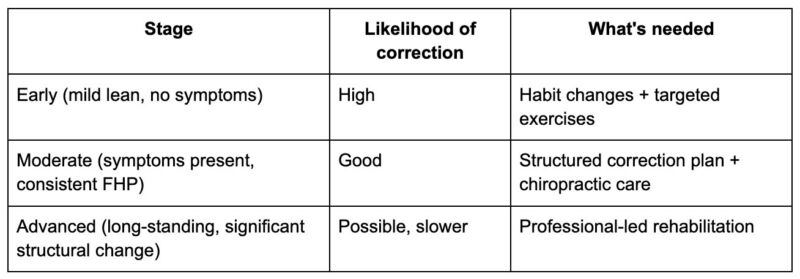
What doesn’t work? Quick fixes. Postural reminders, posture braces worn without addressing the underlying muscle imbalance, and one-time adjustments don’t create lasting change. The same patterns that built FHP over years need to be systematically unwound over weeks and months.
How to Fix Forward Head Posture
Correcting forward head posture requires a two-track approach: changing the habits causing it and actively retraining the muscles and spine.
- Improve daily posture habits Stop reinforcing the pattern. Screen time, desk posture, and phone use are the biggest contributors – and the most controllable.
- Adjust your workstation Your monitor should sit at eye level. Your chair should support the natural curve of your lower back. Your feet should rest flat on the floor.
- Stretch the muscles that are too tight The chest (pectorals) and front of the neck are almost always shortened in FHP. Chest openers and chin tucks help restore normal length.
- Strengthen the muscles that are too weak The deep neck flexors and upper back muscles (particularly the rhomboids and lower trapezius) need deliberate strengthening to hold the head back where it belongs.
- Follow a structured correction plan This is where professional guidance makes the biggest difference. Random exercises done inconsistently won’t move the needle. A specific, progressive plan – tailored to your degree of FHP – will.
When Should You See a Chiropractor?
Exercises and ergonomic improvements help – but they work on muscles and habits. They don’t correct the underlying spinal alignment, which is often the foundation of the problem.
Consider making an appointment if you have:
- Persistent neck pain that doesn’t improve with stretching
- Frequent headaches concentrated at the base of the skull
- Noticeably worsening posture despite your own efforts
- Numbness or tingling in the arms or hands
- A feeling of tightness or fatigue in the upper back that never fully releases
These are signs that structural involvement is at play and that’s exactly what chiropractic assessment is designed to identify.
How Chiropractic Care Helps Correct Forward Head Posture
At our practice as a Chiropractor in Mt. Juliet, TN, we approach forward head posture as a structural problem that requires a structural solution.
Here’s what that process looks like:
Spinal alignment correction – Chiropractic adjustments address the vertebral restrictions in the cervical and thoracic spine that develop as a result of FHP. Restoring proper joint motion is step one of any lasting correction.
X-ray-based assessment – We use spinal X-rays when appropriate to accurately measure the degree of FHP, identify any loss of the natural cervical curve, and track improvement over time. Radiographic evaluation remains essential in the clinical evaluation of forward head posture, giving us an objective baseline rather than guesswork.
Personalized care plan – There is no one-size-fits-all protocol. Based on your findings, we build a structured plan that combines adjustments with specific rehabilitation exercises and ergonomic guidance.
Posture rehabilitation – Adjustments alone aren’t enough. We pair spinal care with active rehabilitation to retrain the muscles that hold the spine in proper position between visits.
Final Takeaway
Forward head posture is one of the most common structural problems we see in adults – and one of the most consistently underestimated. People live with headaches, neck stiffness, and the tension for years before connecting it to how they’re carrying their head.
The good news: in most cases, it can be improved. But the window for easier correction doesn’t stay open forever. The longer FHP goes unaddressed, the more the spine adapts around it and the more effort it takes to change.
Consistency is everything. A few exercises done sporadically won’t create the change you’re looking for. A structured, progressive plan – started sooner rather than later – will.
Book a Posture Evaluation at Tinker Family Chiropractic
If you’re dealing with neck stiffness, recurring headaches, or you’ve noticed your posture creeping forward over the years, it’s worth getting a proper assessment.
At Tinker Family Chiropractic, we offer a comprehensive posture evaluation that includes a spinal check, postural assessment, and a personalized treatment plan built around what we actually find – not a generic protocol.
Understanding what causes forward head posture in your specific case is the first step. Let’s take that step together.
$69
Exam + X-Rays
Once you qualify for care, the doctor will go over the next steps, and any cost associated with care before moving forward.